English

PROBLEM

PROBLEM

How to increase citizen participation in government decisions?

How to increase citizen participation in government decisions?

Context

We simulated a business environment that would be a B2B startup with the federal government, providing data and helping to increase the number of political participation of citizens. This project was built during the UX/UI Design course at Cubos Academy - March to August 2023.


Check it out in English.

Context

We simulated a business environment that would be a B2B startup with the federal government, providing data and helping to increase the number of political participation of citizens. This project was built during the UX/UI Design course at Cubos Academy - March to August 2023.


Check it out in English.

My role

I was responsible, alongside Mika Santos, for the entire project process (from research to the creation of the interface and testing), with the participation of Juliana Cirino, Pedro Tavares, and Antônio Messias.

phase 01 | discovery

phase 01 | discovery

our first questions

our first questions

our first questions

our first questions

Through a desk research, we seeked to answer the initial questions that arose in our minds and better understand the topic itself.

How does political participation work in Brazil?

How does political participation work in Brazil?

How is the participation scenario today?

How is the participation scenario today?

What is the role of digital media in participation?

What is the role of digital media in participation?

Civic participation is a right provided for by law and in the constitution. But only 6% of people believe that exercising democracy through direct participation, beyond voting, is effective. This stems from a history of corruption and lack of social return in the country.

(PUC-RS, 2020)

Various research studies prove and measure that participation is something positive for the population in general, brings a sense of belonging and an educational process regarding politics, and that having mere contact with it already awakens interest and motivation.

(UFBA, 2010)

From the perspective of public management, the means of participation (with the main ones being consultations, councils, and ombudsmen) generate a very high demand and there is a lack of means to systematize this into information that can be consumed by managers. There are also insufficient means to present the results to the population.

(Sectoral Dialogues EU-Brazil, 2012)

The expansion of access to technology has increased the population's interest in the pursuit of rights and improvements, and the internet is indeed effective as an enhancement in participation, with examples from Brazil and around the world - the strongest being those of Participatory Budgeting.

(Pólis Institute, 2011)

However, the participation of people in online polls, forums, voting, and public consultations is still low.

(UFERSA, 2020)

what tools already exist on the internet?

what tools already exist on the internet?

what tools already exist on the internet?

what tools already exist on the internet?

We conducted a benchmarking of 8 platforms that deal with political participation in Brazil, and all had at least one of these problems:

  • Be just a means of consulting information, and not of participation;

  • Don't say too much to someone who doesn't understand bureaucratic matters;

  • Do not deal with real projects, but with proposals from the population;

  • Be paid and directed to companies.

why do people not participate enough?

why do people not participate enough?

why do people not participate enough?

why do people not participate enough?

This became the X of the matter when we realized that we could take two different paths: one, focused on the people who work in public management; and another, focused on the citizenry.


We made a decision focused on participation itself.


In order to address this issue, we extended some research for the CSD Matrix, defining the main certainties, and of all the assumptions and doubts raised, here we highlight only those that we moved forward for validation using the Relational Map:

certainties

certainties

The means of participation today are EMPTY, COMPLEX, and DISPERSED.

The means of participation today are EMPTY, COMPLEX, and DISPERSED.

Participation spaces are exclusive and unequal, with extreme LACK OF REPRESENTATION.

Participation spaces are exclusive and unequal, with extreme LACK OF REPRESENTATION.

The most impactful demonstrations in the recent history of Brazil and the world were articulated by SOCIAL NETWORKS, and DIGITAL MEDIA is the political information medium for 85% of young people.

The most impactful demonstrations in the recent history of Brazil and the world were articulated by SOCIAL NETWORKS, and DIGITAL MEDIA is the political information medium for 85% of young people.

Schooling is a very relevant factor, being directly proportional to interest, understanding, political engagement, and presence in elections.

Schooling is a very relevant factor, being directly proportional to interest, understanding, political engagement, and presence in elections.

assumptions

assumptions

People find it difficult to navigate government portals, which decreases the possibility of generating knowledge.

People find it difficult to navigate government portals, which decreases the possibility of generating knowledge.

The electoral system is not enough to meet the hopes of the population and ICTs would be a solution.

The electoral system is not enough to meet the hopes of the population and ICTs would be a solution.

There is greater virtual engagement with the causes than mobilization in the streets.

There is greater virtual engagement with the causes than mobilization in the streets.

Citizen political decisions, such as voting, are linked to common sense and not directly to secure and factual information.

Citizen political decisions, such as voting, are linked to common sense and not directly to secure and factual information.

questions

questions

What prevents people from getting involved/engaging in political issues?

What prevents people from getting involved/engaging in political issues?

What motivates people to engage in political issues?

What motivates people to engage in political issues?

What is the experience of participating in politics as a citizen?

What is the experience of participating in politics as a citizen?

For the voter, is it more important to align their vote with certain agendas or with the personal figure of the candidate or party?

For the voter, is it more important to align their vote with certain agendas or with the personal figure of the candidate or party?

user research

user research

user research

In analyzing the user research, we identified macro themes at each stage, which transformed throughout this discovery process, and served as a basis for elaborating the Top Insights:

questionnaire

questionnaire

engagement

engagement

engagement

information

information

information

identification

identification

identification

interviews

interviews

engagement

engagement

engagement

information

information

information

identification

identification

identification

conflicts

conflicts

conflicts

in-person participation

in-person participation

in-person participation

top insights

top insights

engagement

engagement

engagement

social networks

social networks

social networks

identification

identification

identification

conflicts

conflicts

conflicts

participation

participation

participation

140 people answered our questionnaire

140 people answered our questionnaire

Our survey had 13 questions, and the profile of the respondents was:


  • 65% women

  • 51% Black

  • 80% between the ages of 18 and 35

  • 86% have a higher education degree or more

  • 61% have a family income between 1 and 5 minimum wages

  • the vast majority from the Northeast region

Our survey had 13 questions, and the profile of the respondents was:


  • 65% women

  • 51% Black

  • 80% between the ages of 18 and 35

  • 86% have a higher education degree or more

  • 61% have a family income between 1 and 5 minimum wages

  • the vast majority from the Northeast region

engagement

engagement

engagement

50%

have already participated in some activity or event,

have already participated in some activity or event,

and of them, only 5% consider themselves actively engaged today.

Of those who have never participated, 19.5% would like to participate.

31%

In other words, only 31% of people really have no interest in political issues.

89.1%

feel some demotivation. Lack of time, disbelief, and complexity are the main factors.

48%

people seek political information.

information

information

information

People are more informed through social media.

People are more informed through social media.

News and television portals follow.

62.3%

of the people who have already participated have used some government portal or app to get informed about.

78%

These people liked the experience, invalidating one of our assumptions.

identification

identification

identification

37.5%

does not accompany any political management.

24%

these people claim to seek political information, which demonstrates engagement in other ways.

48%

feels that no management takes into account citizen participation.

we understand that consuming information about politics is also a form of participation

we understand that consuming information about politics is also a form of participation

From the analysis of the questionnaire, this understanding arose. The consumption of information is the point where participation begins, and the importance of education had already been validated in the Desk Research.


We began to consider this when talking to people in the qualitative research, seeking to identify what political participation means to people, in order to validate this hypothesis as well.

we interviewed 5 people

we interviewed 5 people

Based on the Questionnaire, we developed 10 questions for a qualitative research focusing more on the reasons and also on how people engage and get involved, both with active participation and with the consumption of political information.


These 5 macro themes emerged from our analysis with the Affinity Map:

Based on the Questionnaire, we developed 10 questions for a qualitative research focusing more on the reasons and also on how people engage and get involved, both with active participation and with the consumption of political information.


These 5 macro themes emerged from our analysis with the Affinity Map:

engagement

engagement

engagement

"I often feel that feeling when it comes close to some political context I get involved in the subject, but I don’t dive deep, you know?"

information

information

information

"I think that the phone is more in the palm of your hand in everyday life and you end up there scrolling through your feeds taking a look and following along."

information

information

information

“I don't know about that, but I've never researched much, so maybe it's my fault.”

information

information

information

"I don’t usually ask people because they generally lead us to a type of thinking, right?"

identification

identification

identification

“I choose my vote thinking about what I believe and what benefits me and the people around me”

conflicts

conflicts

conflicts

"I think my disinterest is more due to the dialogue because I think that the dialogue has become very complicated, you know? Because it has become so heated, you know?"

in-person participation

in-person participation

in-person participation

"Today I am not participating in anything, but I have already participated in demonstrations, meetings, and things like that. I really enjoyed having participated."

phase 02 | deFINIR

phase 02 | deFINIR

we discovered that talking about politics is the weak point

we discovered that talking about politics is the weak point

we discovered that talking about politics is the weak point

We crossed all the information collected:

Desk Research + Questionnaire + Interviews

to summarize the most relevant learnings for building a Persona and defining a problem.

This step caused rework!

When we were further along in the project, we had to go back to this point and redo it. This made all the difference later on, especially in the clarity of the Value Proposition.

participation

participation

participation

Reduction of a participation that was already strong, but interest remains high

Reduction of a participation that was already strong, but interest remains high

Many people have participated actively/in-person (50% of the questionnaire and 100% of the interviewees);


But today they have low participation (20% of the people from the questionnaire and 100% of the interviewees) and it is limited to social networks, focusing on specific contexts of elections or strong outrage (interviews);


70% of people claim to be interested, but 90% report feeling some demotivation (questionnaire).

Many people have participated actively/in-person (50% of the questionnaire and 100% of the interviewees);


But today they have low participation (20% of the people from the questionnaire and 100% of the interviewees) and it is limited to social networks, focusing on specific contexts of elections or strong outrage (interviews);


70% of people claim to be interested, but 90% report feeling some demotivation (questionnaire).

engagement

engagement

engagement

Political education is weak: complexity and lack of trust

Political education is weak: complexity and lack of trust

It is common for people not to take engagement due to fear of not knowing enough, but their behavior shows the opposite (interviews);


The more participation, the more a person feels belonging and strengthens their educational process and political interest (desk research);


35% of people cite complexity as a cause of demotivation (questionnaire);


The majority of these people have a high level of education and still point to this difficulty (questionnaire);


Education is the main factor in political engagement and in improving the unequal situation of participatory processes (desk research).

It is common for people not to take engagement due to fear of not knowing enough, but their behavior shows the opposite (interviews);


The more participation, the more a person feels belonging and strengthens their educational process and political interest (desk research);


35% of people cite complexity as a cause of demotivation (questionnaire);


The majority of these people have a high level of education and still point to this difficulty (questionnaire);


Education is the main factor in political engagement and in improving the unequal situation of participatory processes (desk research).

engagement

engagement

engagement

Disbelief due to the historical lack of communication and social feedback in the country

Disbelief due to the historical lack of communication and social feedback in the country

Historically, the Brazilian population is greatly affected by corruption, which generates a significant disbelief and distrust in politics (desk research);


47% of people point to disbelief as a cause of demotivation (questionnaire);


80% of people claim they cannot communicate with any management (questionnaire);


48% of people feel that no management takes citizen participation into account (questionnaire).

Historically, the Brazilian population is greatly affected by corruption, which generates a significant disbelief and distrust in politics (desk research);


47% of people point to disbelief as a cause of demotivation (questionnaire);


80% of people claim they cannot communicate with any management (questionnaire);


48% of people feel that no management takes citizen participation into account (questionnaire).

conflicts

conflicts

conflicts

The last straw: fatigue with conflicts and political polarization

The last straw: fatigue with conflicts and political polarization

People have already been hurt discussing with people they like, have had relationships broken, and are not willing to take that risk again.


So people even post something on social media, but little and with caution, and do not talk to just anyone ( unanimous among the interviewed people);

4 out of 5 interviewed people mentioned tiredness with the polarized situation of the country.

People have already been hurt discussing with people they like, have had relationships broken, and are not willing to take that risk again.


So people even post something on social media, but little and with caution, and do not talk to just anyone ( unanimous among the interviewed people);

4 out of 5 interviewed people mentioned tiredness with the polarized situation of the country.

social networks

social networks

social networks

Social networks are the preferred means of political engagement

Social networks are the preferred means of political engagement

Social networks (following reliable sources) are the preferred means due to the speed and ease of summarized information (interviews);

47% of people cite lack of time as a cause of demotivation (survey);

85% of people get informed about politics and/or participation events through social networks (survey);

The internet is efficient and has great potential for citizen participation in politics (desk research);

The largest demonstrations are coordinated through social networks (desk research).

Social networks (following reliable sources) are the preferred means due to the speed and ease of summarized information (interviews);

47% of people cite lack of time as a cause of demotivation (survey);

85% of people get informed about politics and/or participation events through social networks (survey);

The internet is efficient and has great potential for citizen participation in politics (desk research);

The largest demonstrations are coordinated through social networks (desk research).

identification

identification

identification

The more belonging, the more engagement

The more belonging, the more engagement

3 out of the 5 people interviewed have participated in street protests, which was very significant in their lives: it made them feel part of something, of a possible change in the country, and it was even moving;


Their political decisions are guided by ideology and by what is best for them and for the people they care about;


For them, there really is no other way than to endorse the government proposals that make sense in their life context. It is the biggest motivation for them to engage (interviews);


It is essential to see results and feedback from their actions and participation - otherwise, there is a political distancing (questionnaire and interviews).

3 out of the 5 people interviewed have participated in street protests, which was very significant in their lives: it made them feel part of something, of a possible change in the country, and it was even moving;


Their political decisions are guided by ideology and by what is best for them and for the people they care about;


For them, there really is no other way than to endorse the government proposals that make sense in their life context. It is the biggest motivation for them to engage (interviews);


It is essential to see results and feedback from their actions and participation - otherwise, there is a political distancing (questionnaire and interviews).

I introduce you to our persona:

I introduce you to our persona:

Isabela

Ferreira

Isabela

Ferreira

"I want to reclaim my political participation in some way, but I am tired of conflicts and afraid it will be very complex because the country is very polarized and my life is very busy."

"I want to reclaim my political participation in some way, but I am tired of conflicts and afraid it will be very complex because the country is very polarized and my life is very busy."

profile

profile

Isa is 28 years old and has lived in Salvador since she was little.

She has a strong sense of responsibility and social justice.

functions

functions

Works as an Administrative Assistant, studies Nursing, and lives with her mother, sharing the household care and expenses.

routine

routine

Works during the day and studies at night, which is why prefers to consume information quickly and objectively through social networks.

objectives

objectives

Isa dreams of achieving a more dignified life and believes that through nursing she can embrace her social sense.

pains

pains

  • Fear of getting involved in conflicts;

  • Fatigue with politics in general;

  • Fear of not knowing enough;

  • Difficulty and helplessness: not knowing how to participate;

  • Thinking that it doesn't make much difference.

  • Fear of getting involved in conflicts;

  • Fatigue with politics in general;

  • Fear of not knowing enough;

  • Difficulty and helplessness: not knowing how to participate;

  • Thinking that it doesn't make much difference.

needs

needs

  • Speed and ease of participation;

  • The ability to consult topics specifically and in a summarized way;

  • Assurance that there will be no conflict;

  • Feeling of belonging;

  • See feedback/results from participation.

  • Speed and ease of participation;

  • The ability to consult topics specifically and in a summarized way;

  • Assurance that there will be no conflict;

  • Feeling of belonging;

  • See feedback/results from participation.

defining the value proposition

defining the value proposition

defining the value proposition

Empathizing with Isa and focusing on her pains and needs, we were able to elaborate the Problem Statement:


Isabela needs to have access to summarized political information, secure and peaceful discussions, and quick and efficient means of participation to feel more confident and belonging as a citizen.

Building an empathy map for Isa and a Value Proposition Canvas, clearer ideas emerged about what we needed to solve and how we could do that. Remembering that it should be through a digital product that had value for Isa in her daily life.

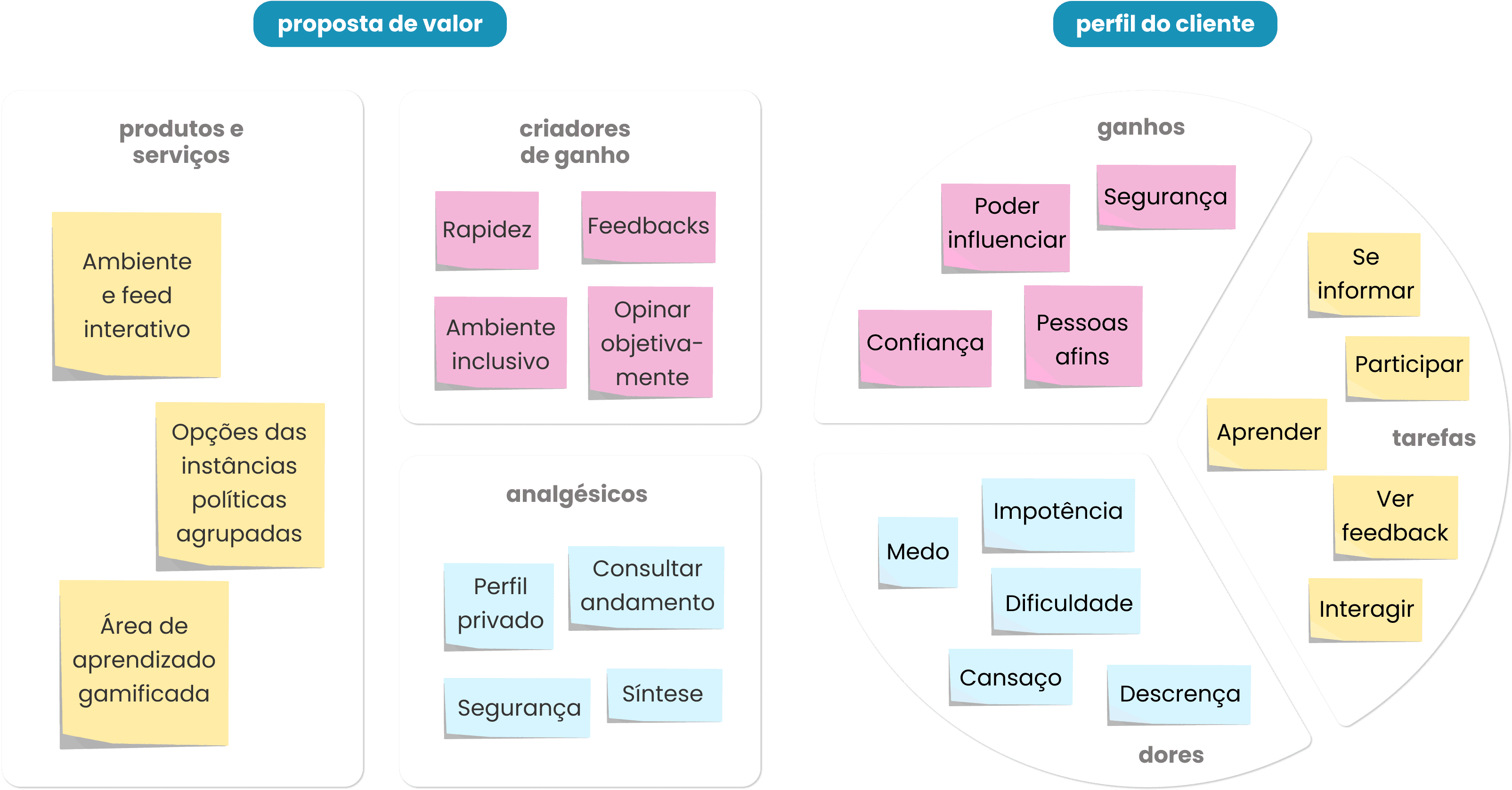
a social network for political participation!

a social network for political participation!

a social network for political participation!

Even though we are in the definition phase, we needed some exercise of expansion to explore ways to materialize this value proposal. We did the exercise "How could we?", and organized the ideas generated by answering these questions using the MoSCoW Matrix, which has 4 regions: "Must have", "Should have", "Could have", and "Won't have". Here, for reasons of synthesis and the very idea of prioritization, we present only the ideas that would cause the product to lose value and meaning if they were not included.


With these two exercises, it became very clear which product we would build as a solution to Isabela's problem.


Facilitating access to political participation would be the differentiator of Vozzz as a social network.

How could we...

...to inform about actions and political issues quickly and easily?

...to inform about actions and political issues quickly and easily?

...encourage the identification and engagement with political agendas?

...encourage the identification and engagement with political agendas?

...help people feel safe and motivated to participate politically?

...help people feel safe and motivated to participate politically?

It has to be!

Functionality where people can check the progress of bills and similar projects.

Functionality where people can check the progress of bills and similar projects.

Interactive environment with the exchange of information and opinions with other users.

Interactive environment with the exchange of information and opinions with other users.

Informing about events, actions, and agendas that are of interest to the user.

Informing about events, actions, and agendas that are of interest to the user.

Show the metric of the person's engagement impact on the profile.

Show the metric of the person's engagement impact on the profile.

The user will be able to choose which managements they want to monitor and interact with.

The user will be able to choose which managements they want to monitor and interact with.

Learning tool that can be fun and easy to understand.

Learning tool that can be fun and easy to understand.

materializing features in interfaces

materializing features in interfaces

materializing features in interfaces

We did the Crazy 8s, a creative activity where each team member produced various quick sketches developing ideas on how to turn feature ideas into usable interfaces.


As many ideas emerged, these sketches are still in the definition phase, and not in development, as we still need to go through another prioritization process after this. These sketched ideas were filtered through an Impact X Effort Matrix, which has 4 regions: "Not a priority", "If we have time, we will do it", "We need to analyze", and "We will do it". Below, I show only the screens we prioritized to work on and that were incorporated into the final prototype.

registration

registration

registration

registration

registration

registration

home/feed

home/feed

home/feed

home/feed

home/feed

home/feed

participation

participation

participation

participation

participation

participation

phase 03 | deVELOP

phase 03 | deVELOP

flows between the user's network and participation

flows between the user's network and participation

flows between the user's network and participation

Our User Flow was well detailed, with many tasks. We realized how complex the product we were creating was, and how it would have many features, which could make our work difficult going forward. But we continued, as after reviewing a lot, we had no doubts that we were aligned with Isa's pain points and needs.


We sought to map mainly the flows that would lead the user’s network to interact with the political participation tools. This gave us essential clarity to understand what should be present on each screen and how to organize the information logically and intuitively.


Below, a basic site map of the defined information architecture.

taking advantage of patterns and creating new ones

taking advantage of patterns and creating new ones

taking advantage of patterns and creating new ones

We created some low-fidelity wireframes and a major misunderstanding led us to decide to move quickly to medium fidelity. This choice allowed us to give a more solid structure to the product, as well as accelerate our learning in using Figma with components and autolayout, which greatly sped up the work.


We conducted another Benchmarking to learn about the visual and interaction structure of the social networks that made the most sense to the interviewed people: Instagram and Twitter.


Our goal was to provide a familiar and comfortable experience for users, so they felt in a known environment.


Swipe to see the screens:

Low fidelity

Medium fidelity

style guide

style guide

style guide

The first decision of the Style Guide was to work with 3 colors, to convey the diversity that exists and should exist, of opinions, cultures, and contexts in Brazil.
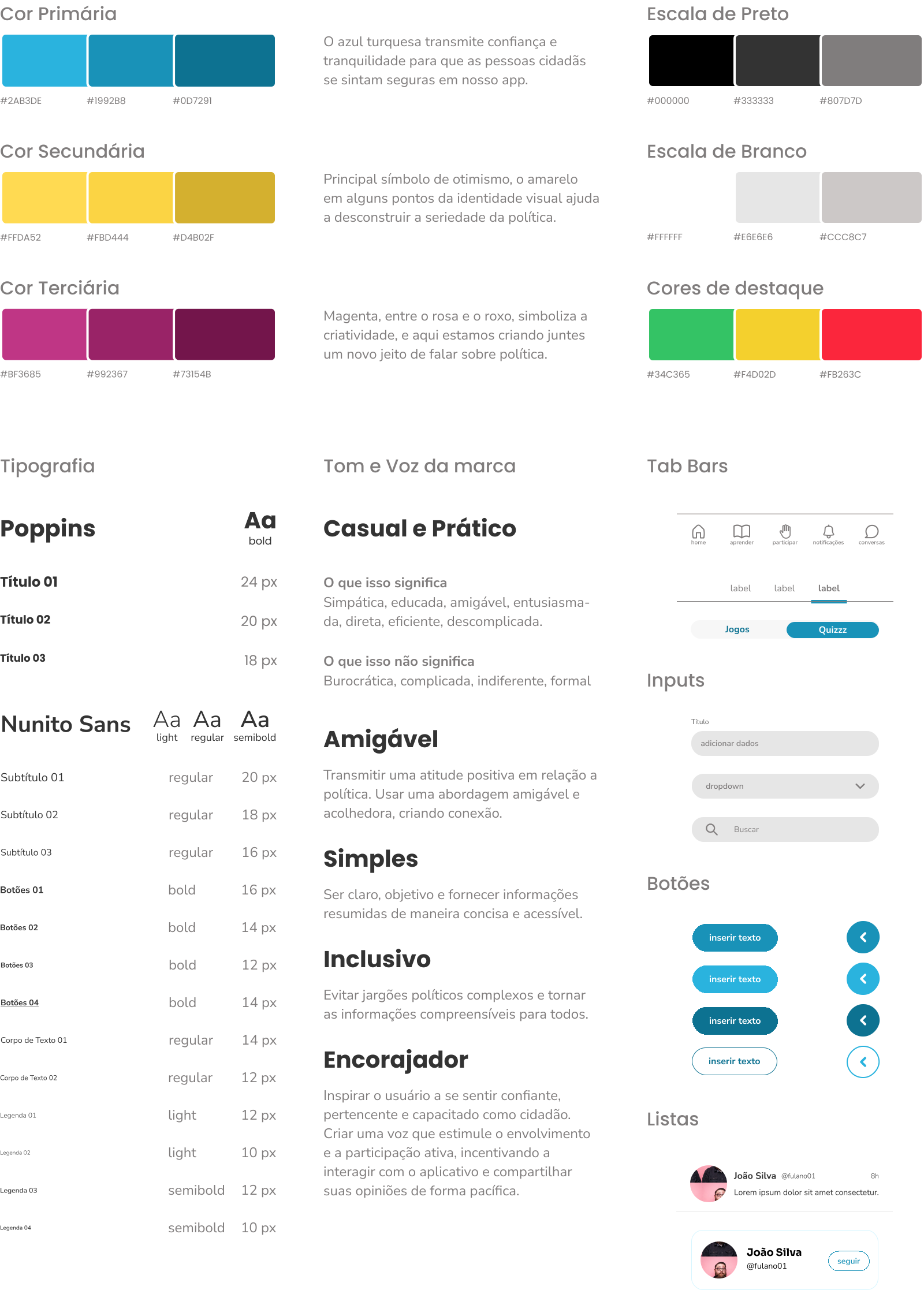
logo design

logo design

logo design

We chose the name “Vozzz” with the intention of conveying a new way to talk about politics, renewing how people see themselves participating actively.


The progressive logo represents the voice echoing, freeing opinions, and symbolizing the awakening to civic participation.

May politics be a natural part of everyone's daily life.

Logo applications

Logo applications

phase 04 | DELIVER

phase 04 | DELIVER

prototyping in high fidelity

prototyping in high fidelity

prototyping in high fidelity

In onboarding, we talk about recognizing the speaker's place as a right because civic participation is a right.


With Jakob's Law in mind, we replicate patterns from other established social media interfaces to organize what is new in our information architecture.

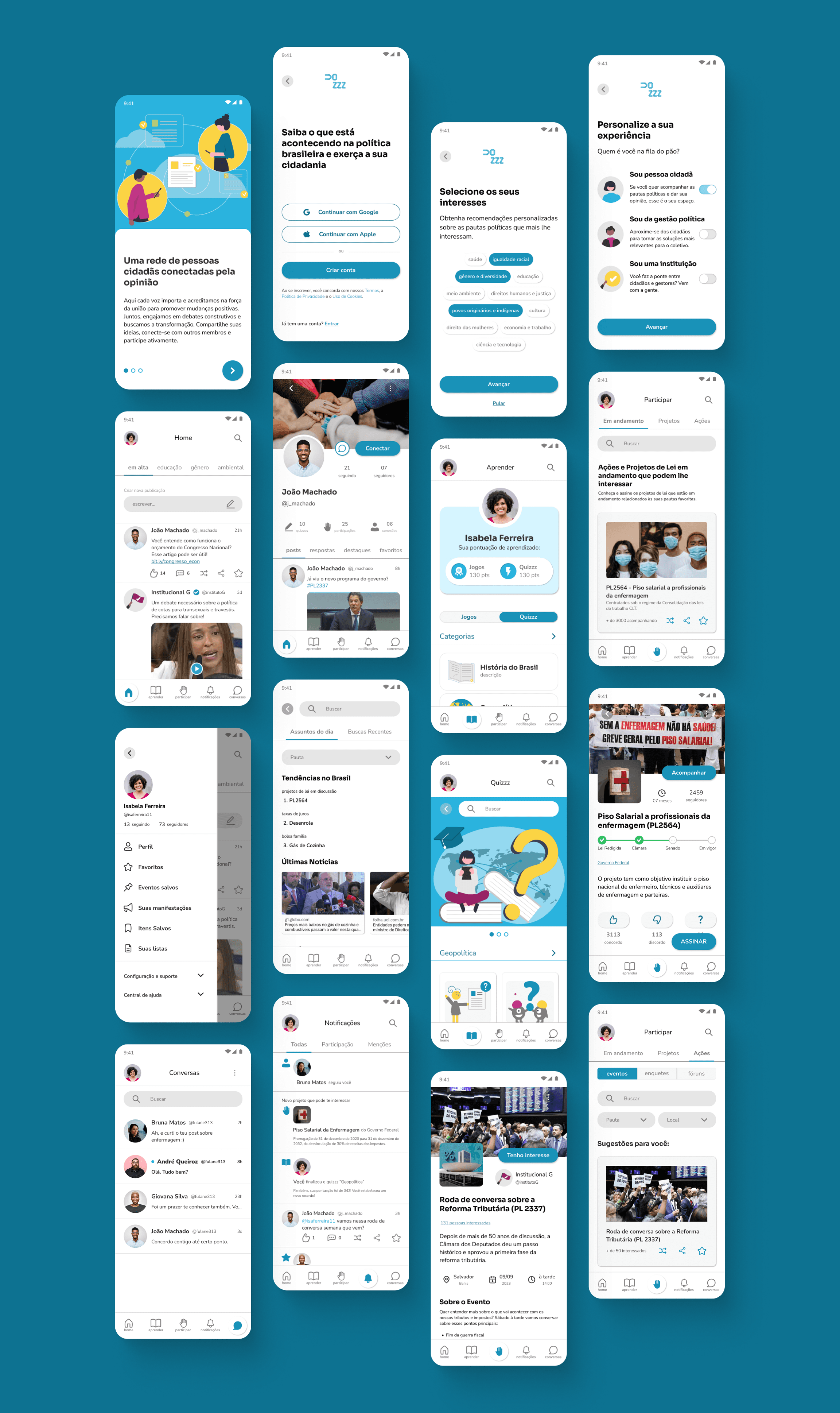
registration flow

registration flow

participation flow

participation flow

learning flow

learning flow

testing with users

testing with users

4 people participated in the test, which was conducted using the Maze tool.


Overall, people were positively surprised by the possibility of having a tool with this purpose. The words "intuitive" and "fluid" were frequently used and we were very happy with the result!

Mission 1: Registration in the app

This mission was practically without difficulties, we just concluded that the spacing of the touch area of the inputs should be a little larger. This difficulty is represented in the first two screens of the heat test below.

Mission 2: To sign a Bill

Here there were two difficulties:


  • One was finding the participation section where this bill was located on the Home screen, so it would be something necessary for us to review. The third screen of the heat test represents this.


  • The other difficulty was that after being redirected to the government website, they had trouble finding the button to click and actually sign the bill, and we discussed how this would be outside of our control, as it is an action that needs to be taken outside of our app, however, we could come up with ways to mitigate this within our interface.
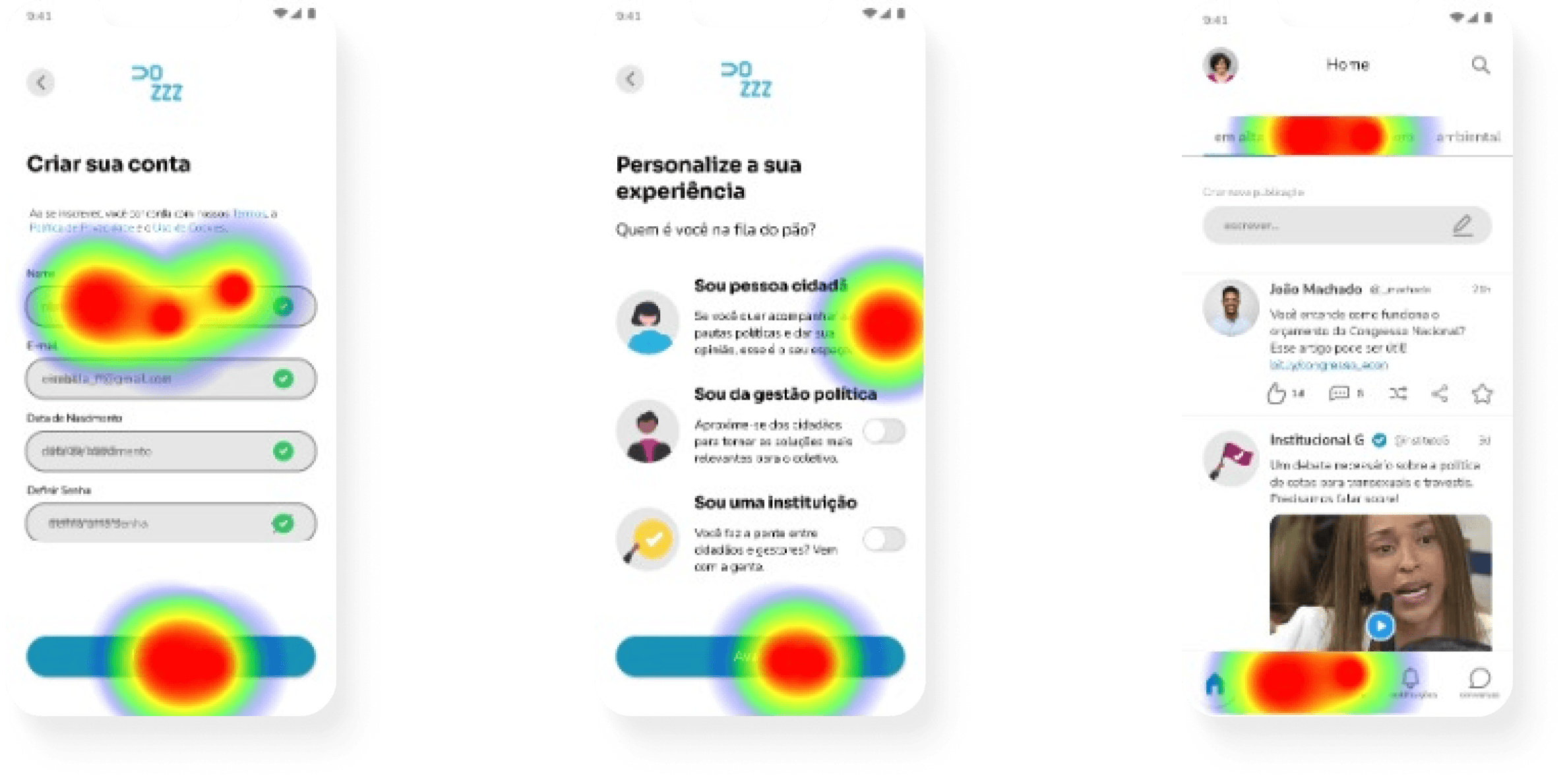
results

and learnings

results

and learnings

results

and learnings

With more time, in addition to this issue of redirection, what I consider more important would be to redo some components, especially the feed posts and the label bars (increasing the touch area and simplifying the options), and I would conduct another more extensive usability test. In it, we should measure some key outcome metrics, such as completion time and success rate of participation and posting tasks. This work is ongoing today.


With the development of the application, to ensure and monitor the expected business results from the federal government (which would be the increase in the number of people in participatory actions; and data on behavior, interests, and political opinions of the user individuals, which would depend on the retention of active users) the following key performance indicators should be monitored:


  • percentage of users by completed participations;

  • viral coefficient;

  • retention rate;

  • click-through rate per user;

  • time on screen.

New insights from the usability test:


We can see based on the usability test that the solution to the main pain point, which was the weight of conflicting dialogues about politics, was well addressed with the social networking features of Vozzz. We still need to test and iterate ways to better mediate and alleviate the issues related to redirecting participatory actions to external pages (such as those of the government) through our interface.

Thank you for exploring Vozzz so far!

Thank you for exploring Vozzz so far!

Get in touch with me for work or to talk about design!

nathaliamaol@gmail.com

Itajaí, SC - Brazil

made by Nathalia Marcello from the

with

and

Get in touch with me for work or to talk about design!

nathaliamaol@gmail.com

Itajaí, SC - Brazil

made by Nathalia Marcello from the

with

and

Get in touch with me for work or to talk about design!

nathaliamaol@gmail.com

Itajaí, SC - Brazil

made by Nathalia Marcello from the

with

and

Nathalia

Marcello

English

Nathalia

Marcello

English

Create a free website with Framer, the website builder loved by startups, designers and agencies.